

Last updated September 25, 2026
Pool plastering in Los Angeles means applying a new plaster surface to the inside of a swimming pool to restore its finish and durability, and standard white plaster runs roughly $6 to $9 per square foot of interior surface, which puts most residential jobs between $4,000 and $10,000 depending on pool size.
Pool replastering cost, short answer: standard white plaster runs about $6 to $9 per square foot of interior surface in Los Angeles, which is roughly $4,900 to $7,300 on the most common 14 by 28 pool. Quartz and pebble finishes cost more and last longer. The table below breaks it down by pool size and finish.
The range is wide because a pool is priced by its interior surface area, not by the square footage of your backyard or the gallons it holds.
If your plaster feels like sandpaper underfoot, if gray concrete shows through, or if you fight stains every spring, the pool’s surface has reached the end of its life, and waiting too long can turn a surface problem into bigger repair and maintenance costs. Mineral-heavy water makes that arrive sooner on La Crescenta pool surfaces.
For Los Angeles homeowners weighing pool plastering or resurfacing, this guide breaks down cost by pool size, how pricing is calculated, finish options and their durability, the surface prep and project steps involved, when resurfacing is enough versus a full renovation, and how to vet local contractors before you book.
Measure Your Swimming Pool First, Then Price It
Your interior surface area is the pool floor plus every wall from the waterline down, and that total is the number a plaster crew prices against.
For a rectangular in-ground pool, the working formula is simple.
Multiply length by width, then add the perimeter multiplied by the average depth.
A 14 by 28 foot pool with an average depth of 5 feet works out to 392 square feet of floor plus 420 square feet of wall, or about 810 square feet total.
Two pools with the same footprint can still price differently, because a deep-diving well adds wall area fast, and wall area is plaster.
Walk out with a tape measure and get length, width, shallow-end depth, and deep-end depth.
Four numbers are all any honest estimator needs to give you a real figure over the phone.
How Pool Plastering Is Priced in Los Angeles
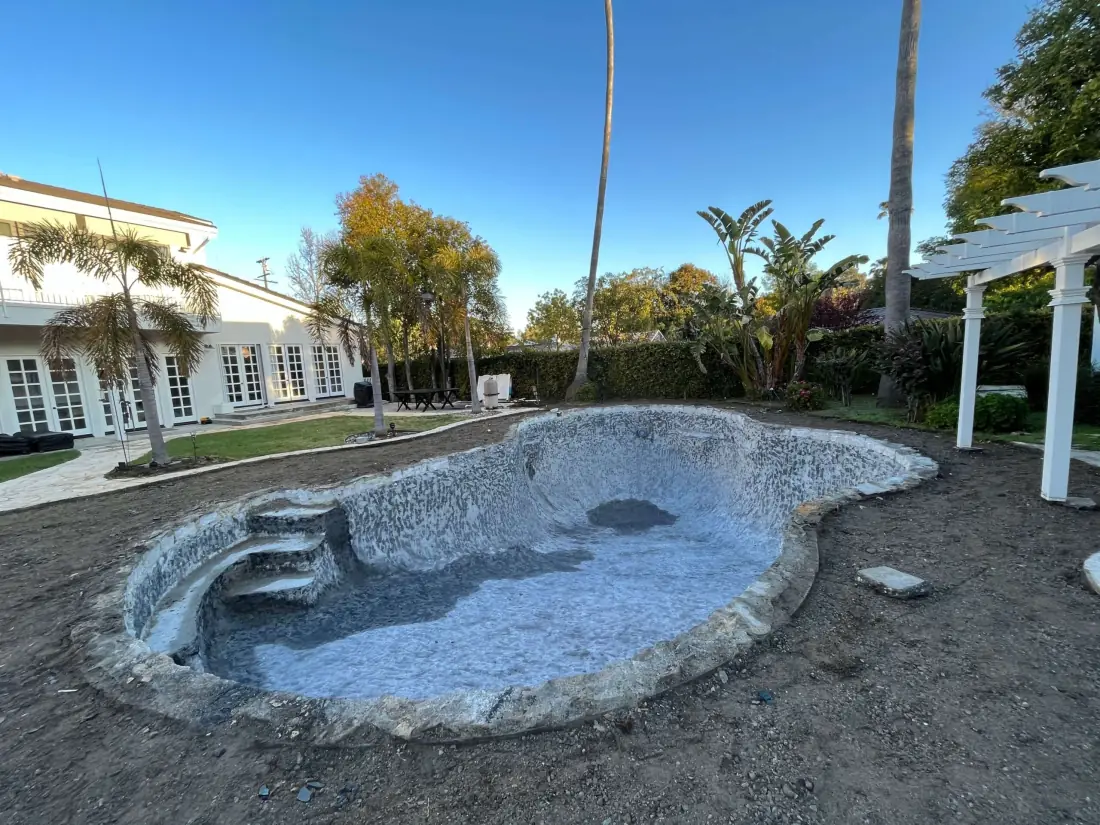
Pool plastering is priced per square foot of interior surface, then adjusted for the condition of the shell underneath and the finish material you pick. Access can add to it on the tight lots behind Toluca Lake pool remodels.
Here is what four common Los Angeles pool sizes translate to at 2026 pricing.
| Pool size | Approx. interior surface | Standard white plaster | Quartz finish | Pebble finish |
|---|---|---|---|---|
| 10 x 20 plunge pool | ~440 sq ft | $2,600 to $4,000 | $3,500 to $5,300 | $4,400 to $6,600 |
| 14 x 28 (most common) | ~810 sq ft | $4,900 to $7,300 | $6,500 to $9,700 | $8,100 to $12,200 |
| 16 x 32 | ~1,040 sq ft | $6,200 to $9,400 | $8,300 to $12,500 | $10,400 to $15,600 |
| 20 x 40 | ~1,520 sq ft | $9,100 to $13,700 | $12,200 to $18,200 | $15,200 to $22,800 |
Published cost data disagree on the per-foot number, and the spread is worth understanding.
Homewyse puts basic replastering at $6.63 to $7.90 per square foot as of May 2026, and HomeGuide’s 2026 figures put plaster at roughly $6 to $8 per square foot with pebble or aggregate at $5 to $10.
Handoff’s Los Angeles construction cost data runs higher at $7.10 to $15.24 per square foot, because that band covers every finish from white plaster to polished aggregate.
Older contractor sources still quote $4 to $7, which reflects material costs from several years ago and no longer holds in coastal California.
The sources measure different things, because some price materials and labor only while others fold in crack repair, waterline tile, and the acid wash.
Treat any number under $5 per square foot in Los Angeles as a bid that has not yet included surface preparation. Larger backyard pools sit at the upper end of the range, which is common on plaster work in Woodland Hills.
If your existing surface is failing rather than just tired, pool plastering is the correct fix, and the assessment is free.
Finish Options and What Each One Costs to Live With
The finish you choose changes both the upfront price and how many years of life you get before the next project.
Four materials cover almost every residential concrete pool in the surrounding area, and each one trades price against durability and aesthetics.
Standard White Plaster
Standard white plaster is a mix of white cement and marble sand applied about 3/8 inch thick, and it seals the porous concrete shell underneath.
It is the most economical option and gives you that classic bright blue watercolor.
Expect 5 to 10 years of life, and expect staining and etching sooner than the aggregate finishes.
Quartz Finish
Quartz finish blends crushed quartz into the plaster for stain resistance and color range.
Durability improves noticeably; 10 to 15 years is a fair expectation, and the water reads deeper and richer than it does over white plaster.
Pebble Finishes
Pebble finishes press small natural stones into the surface for a textured, slip-resistant floor.
These are the most durable finishes and the most durable materials available at this price point, with 15 to 20 years of service.
The texture hides staining well, though some homeowners find it rough on bare feet.
Polished Aggregate
Polished aggregate is a pebble surface ground smooth and buffed to a reflective sheen.
It costs more than standard pebble and can enhance the beauty of the water more than any other option here.
Color transforms the result more than most customers expect, because a white surface reads bright turquoise, medium gray reads deep blue, and dark blue or black reads almost like a natural pond.
Ask to see samples in daylight rather than under showroom lighting, because water and sun shift every color.
The Los Angeles Line Items Nobody Quotes You Upfront
Two costs specific to Los Angeles rarely appear in a phone estimate, and together they can add several hundred dollars to the project. Both show up on almost every quote, including pool plastering in Encino.
The first is refilling the pool.
Municipal water runs roughly $4 to $10 per 1,000 gallons, so a 20,000-gallon swimming pool costs about $80 to $200 to refill on your LADWP bill.
An 810-square-foot pool at 5 feet average depth holds close to 15,000 gallons, which lands in the $60 to $150 range.
That volume also pushes your household into higher usage tiers for the billing cycle, so the real bill impact is often larger than the raw water cost.
The second is how the old water leaves your property, and the City of Los Angeles Watershed Protection Program allows residential pool discharge to the storm drain only under specific conditions.
Chlorine residual cannot exceed 0.1 ppm, pH must sit within 6.5 to 8.5, and discharge is permitted only during the overnight window.
Water containing copper-based algaecide cannot go to the storm drain at all and has to be routed to the sanitary sewer.
The city publishes its full guidance for pool and spa owners on the LA Stormwater site.
Skilled professionals handle dechlorination and legal discharge as part of the job, while a cut-rate crew opens a hose into the gutter and leaves the citation with the property owner.
Preparing the Pool’s Surface Before Any Plaster Goes On
Surface preparation decides whether the new plaster lasts 10 years or delaminates in 18 months, and it is the stage cheap bids cut.
The pool is drained completely, and the hydrostatic relief valve in the main drain is opened first.
Groundwater pressure under an empty shell can float a concrete pool out of the ground, a five-figure problem good crews prevent with one step.
Loose plaster is then chipped out, and crews sound the whole surface with a hammer to find hollow spots that will fail no matter what goes over them.
Structural cracks in the gunite get routed out and packed with hydraulic cement, and any exposed rebar is treated before it keeps rusting.
A bond coat goes on next.
This thin cement slurry gives the new plaster something to grip and is the single biggest factor in adhesion on a replaster.
The shell is then power washed and acid washed to strip residue and open the pores of the concrete.
A final walkthrough confirms the surface is clean, damp, and free of debris before mixing starts, and that level of detail is what separates quality work from a fast bid.
What Happens During the Project, Step by Step
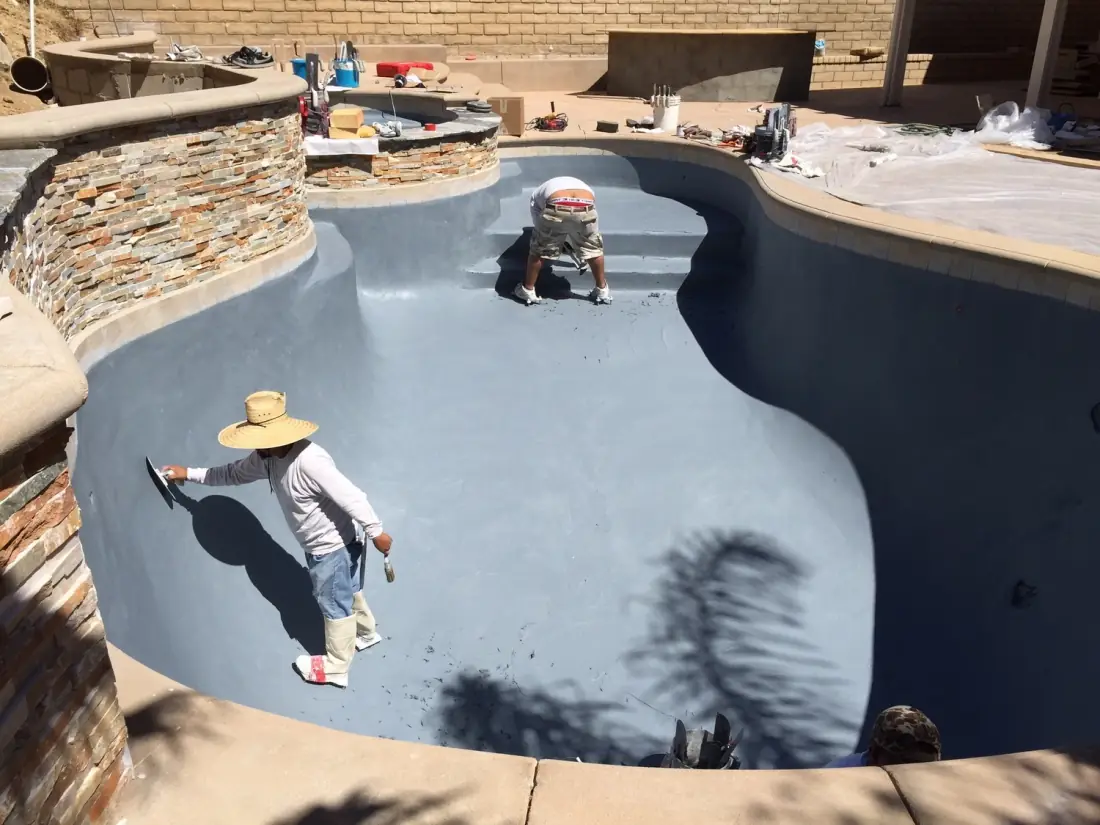
A pool plastering project runs 5 to 7 days from drain to refill for most residential pools, and your only responsibility is keeping the yard and side gate accessible.
Professional crews reduce failure risk because plaster has a working window measured in hours, and once mixing starts, the whole process has to finish that day.
Step 1: On-Site Assessment and Written Quote
A proper assessment measures the shell, sounds for hollow plaster, checks the tile line and coping, and inspects the equipment pad.
Ask for an itemized estimate that separates surface area, finish material, crack and substrate repair, tile or coping work, startup chemicals, and water.
A single lump sum with no breakdown makes change orders impossible to test later.
Step 2: Surface Prep, Repair, and Bonding
Chipping, crack repair, and bond coat application usually take two to three days.
The bond coat needs proper cure time before plaster goes over it, and rushing this step is the most common cause of premature failure.
Step 3: Plaster Application and Curing
Plaster is mixed to the consistency of thick cake batter and pumped in starting at the deepest point, then troweled upward in a continuous pass with the shallow end and steps finished last.
The pool is filled immediately and without stopping, because a waterline that pauses partway leaves a permanent ring.
Filtration runs continuously, a technician brushes the surface daily, and follow-up visits handle chemical checks through the startup period.
Full curing takes about 28 days, and maintaining balanced water during those weeks decides how the surface ages for the next decade.
When a Full Pool Renovation Beats Simple Resurfacing
Full pool renovation makes sense when the surface is only one of several things reaching the end of life, which is typical on pools built before 2005.
Simple resurfacing replaces the plaster and nothing else.
A full renovation covers waterline tile, coping stone, deck work, plumbing, and equipment in the same mobilization, which saves money because the pool is already drained and the site is already staged. It is also the cheapest moment to add a shallow lounging shelf.
The upgrades customers ask for most are LED color-changing lighting, variable-speed pumps that cut electricity use sharply, phone-controlled automation, glass or porcelain tile, tanning ledges, and vanishing edges. Those upgrades fall under LED lighting and smart pool controls.
A renovation at this scale typically runs $5,597 to $15,775, according to HomeAdvisor, and takes a few weeks depending on scope.
Comprehensive services in one pool remodeling project create the dream pool and backyard oasis a 1980s house was missing, and can transform an older pool and yard in a way that changes daily life.
For many homeowners, these projects finally turn long-planned backyard dreams into a finished space.
If you are weighing the numbers, this breakdown of what pool upgrades actually return at resale is a useful starting point.
Signs You Are Paying for Skill, Not Just Materials
The plaster mix is close to identical across every bidder in your driveway, so what you are buying is preparation and crew skill.
Hiring a contractor licensed with the California State License Board and carrying current liability coverage is the floor, and you can verify any license number yourself on the CSLB site.
A team that does its own chipping, plumbing, tile, and coping in-house controls its own schedule, so homeowners can rely on one team instead of a chain of subcontractors, while companies that subcontract each trade lose weeks every time a sub reschedules.
Ask how many pools the crew has finished in your city, because a business with many years of local work already knows your soil, your slope, and your permit counter.
Ask what happens if a crack opens at month six, and get the answer in writing before you sign so the company will stand behind the repair terms.
A trusted name takes pride in its reputation, and integrity shows up in the paperwork long before it shows up in the plaster.
The 9 questions in this guide to vetting a swimming pool renovation company will separate the professional bids from the rest.
Recent projects tell you more than any brochure, so ask to see before-and-after photos of pool resurfacing in your neighborhood in the finish you are considering.
Coverage Across the San Fernando Valley and Surrounding Area
Coverage spans more than 25 communities across Los Angeles County for residential in-ground pools, including Winnetka, Canoga Park, Woodland Hills, Tarzana, Reseda, Northridge, Chatsworth, West Hills, Encino, Van Nuys, Granada Hills, Lake Balboa, Valley Village, Sherman Oaks, Studio City, Toluca Lake, Burbank, Glendale, Pasadena, Altadena, La Crescenta, Agoura Hills, Oak Park, Westlake Village, and Thousand Oaks.
Homeowners in these cities can schedule an on-site measurement the same week they call.
If your city is not listed, call and ask, because the service radius stretches further on larger projects.
Can You Perform Pool Resurfacing Over Existing Plaster?
Resurfacing over existing plaster is possible only when the old surface is sound, fully bonded, and free of hollow spots.
Resurfacing means applying a new layer over a prepared existing surface, while replastering means chipping the old plaster off down to the gunite and starting fresh.
Most pools past 10 years need the full replaster, because layering new plaster over delaminating material guarantees the new coat fails with the old one.
A crew sounds the entire shell with a hammer during the assessment and tells you which one your pool needs.
How Long Until the Pool Is Ready to Swim?
The pool is ready to swim in about 7 to 14 days after plastering, though full curing takes roughly 28 days.
Filling begins the same day the plaster goes on and cannot be interrupted.
For the first two weeks a technician brushes the surface daily to remove plaster dust and balances pH, alkalinity, and calcium hardness.
Swimming is generally safe once chlorine, pH, and alkalinity hold steady across two consecutive tests.
Avoid pool vacuums with wheels and any salt system startup until the 28-day mark.
What Is Included in a Pool Plastering Quote?
A pool plastering quote should include draining and legal water disposal, chipping out old plaster, crack and substrate repair, bond coat application, the plaster or aggregate material, troweling and finishing, acid wash, refill supervision, startup chemicals, and daily brushing through the first week.
Confirm in writing whether waterline tile, coping, deck work, and permits are included or billed separately.
Ask specifically who pays for the water, because that line moves between the contractor and the homeowner from bid to bid.
How Often Does Pool Plaster Need to Be Replaced?
Pool plaster needs to be replaced roughly every 10 to 15 years, though the real number depends on the finish and how the water was maintained.
Standard white plaster typically lasts 5 to 10 years in Los Angeles conditions.
Quartz finishes hold up 10 to 15 years, and pebble finishes commonly reach 15 to 20 years.
Chronically low pH or low calcium hardness dissolves plaster from the surface down and can cut any of those numbers in half.
Rough patches, spreading stains, and visible cracks are the earliest warning signs your pool needs a new surface.
Schedule Your Free On-Site Quote
The fastest way to discover your real price is a 20-minute site visit where the shell is measured, sounded, and inspected, and you leave with an itemized written estimate.
Call (818) 719-9059 to schedule your free assessment.
Office hours are Monday through Friday, 8:00 AM to 3:00 PM.
This is a family-owned business with decades of local work behind it, licensed and insured under CSLB #1143895, and we look forward to helping with your assessment and next resurfacing project.
Bring your four measurements, and you can have a price in hand this week.